 By Madhavan A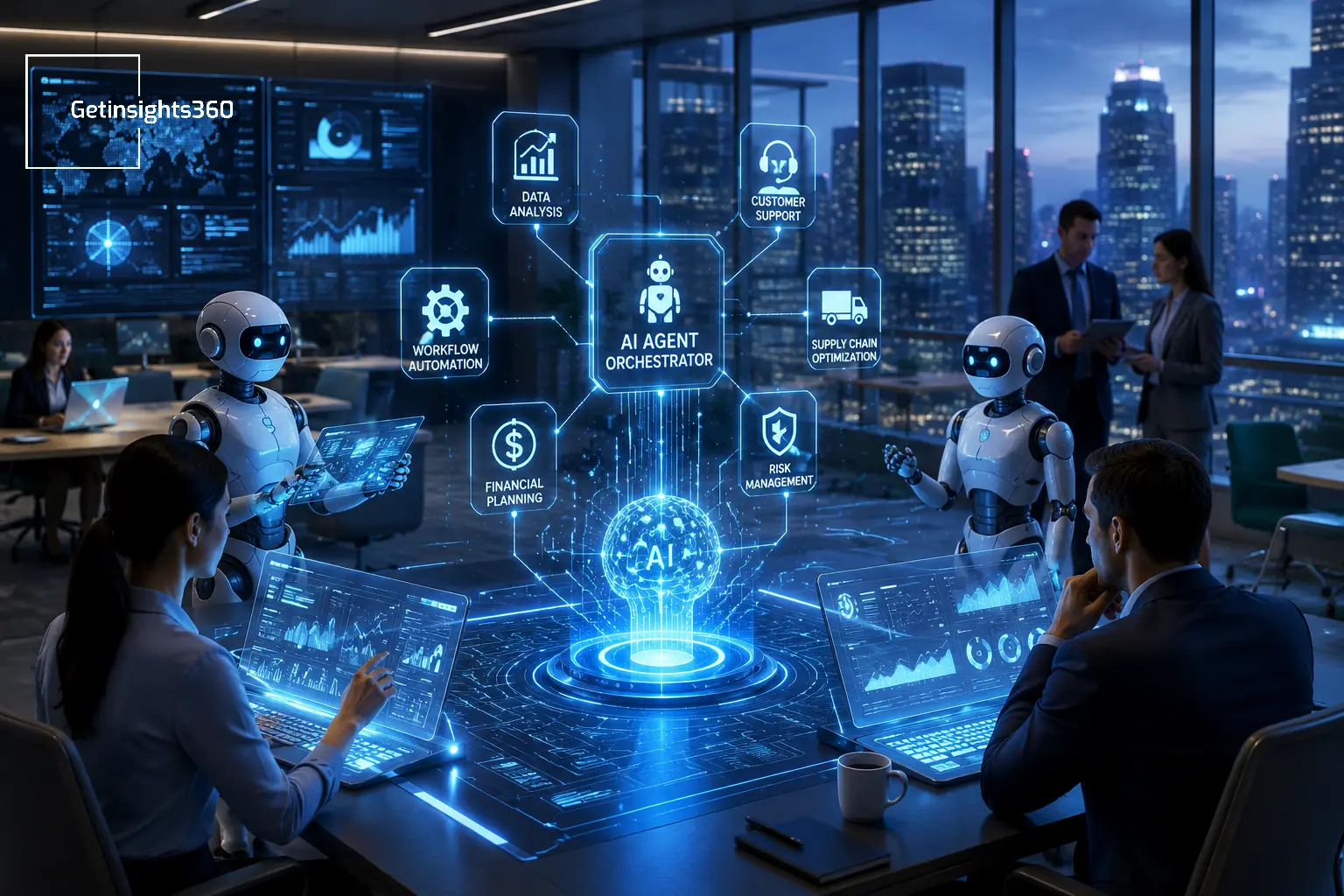
The enterprise landscape has undergone a seismic shift. While 2023 and 2024 were defined by generative AI experimentation — chatbots, copilots, and content generators — 2026 has become the era of Agentic AI for Enterprises. Organizations are no longer asking what AI can do in a controlled demo. They are deploying autonomous AI agents that plan, reason, act, and iterate across complex business workflows — with minimal human intervention.
This is not an incremental upgrade. It is a fundamental reimagining of how enterprises operate.
What Is Agentic AI — and Why Does It Matter Now?
Unlike traditional AI models that respond to a single prompt and stop, Enterprise Agentic AI refers to systems of intelligent agents capable of taking multi-step actions toward a defined goal. Among the many types of artificial intelligence — from narrow rule-based systems to generative models — agentic AI represents the most autonomous and action-oriented category, capable of pursuing multi-step goals with minimal human direction. These agents perceive their environment, make decisions, call tools, execute tasks, evaluate outcomes, and self-correct — all in a continuous loop.
Think of an AI agent not as a smart assistant waiting for instructions, but as a digital colleague that receives a high-level objective and figures out how to accomplish it. When multiple agents collaborate in what are called multi-agent systems, the results scale exponentially. One agent researches. Another drafts. A third reviews. A fourth pushes to production. The entire workflow completes in minutes, not days.
In 2026, the maturity of large language models, the proliferation of reliable tool-calling APIs, and the falling cost of inference compute have made Agentic AI solutions production-ready for the enterprise. The window of competitive advantage is open — but it won’t stay open long.
Key Enterprise Agentic AI Use Cases Driving Adoption
1. AI Agent Automation in Finance and Compliance
Finance teams are deploying autonomous AI agents to handle end-to-end processes that previously required armies of analysts. A single enterprise AI agent today can ingest financial reports, reconcile data across ERP systems, flag anomalies, generate variance reports, and route exceptions to the appropriate human decision-maker — all without manual handoffs.
Compliance is an especially high-value domain. Regulatory requirements change constantly. Agentic AI in enterprise applications monitors regulatory feeds, maps new requirements to existing policies, identifies gaps, and drafts remediation plans — compressing compliance review cycles from weeks to hours.
2. Agentic AI for Customer Support
Modern enterprises are replacing tiered support queues with intelligent AI agents that do far more than answer FAQs. In 2026, customer-facing agents resolve complex multi-step issues: they look up account history, initiate refunds, coordinate with logistics APIs, escalate to specialists when needed, and follow up — all within a single interaction thread.
The result is a dramatic improvement in resolution rates and customer satisfaction, with measurable reductions in support headcount costs. More importantly, these agents learn from every interaction, continuously improving their decision-making over time through reinforcement signals and human feedback loops.
The Fin AI agent blueprint for customer service highlights how enterprises can integrate AI agents into customer support workflows to automate routine tasks, accelerate resolutions, and enhance the customer experience.
3. Agentic AI for Supply Chain Management
Supply chain disruption remains one of the costliest challenges for global enterprises. Agentic AI for supply chain management is proving to be a decisive advantage. Agents monitor supplier signals, port congestion data, commodity price fluctuations, and internal inventory levels simultaneously. When a risk is detected, they don’t just alert — they act. They identify alternative suppliers, re-sequence production schedules, update procurement orders, and notify logistics partners, all in coordination with each other.
This is enterprise workflow automation at its most powerful: real-time, data-driven, and fully orchestrated without requiring a human to touch every step.
4. Software Development and IT Operations
Development teams are embedding AI agents for workflow automation directly into their CI/CD pipelines. These agents review pull requests, write unit tests, identify security vulnerabilities, suggest refactors, and even deploy patches to staging environments. In IT operations, agents monitor infrastructure health, detect anomalies, correlate logs across systems, and initiate remediation — often resolving incidents before human operators are even notified.
This category of AI-powered business operations is delivering some of the fastest measurable ROI in enterprise AI adoption, with incident resolution times dropping by 40–60% in early deployments.
5. Agentic AI for Business Process Optimization
From HR onboarding to legal contract review to marketing campaign management, business process automation with AI is being rebuilt from the ground up around agent architectures. Multi-agent pipelines handle document ingestion, classification, extraction, approval routing, and archiving — with humans involved only at clearly defined decision checkpoints.
Enterprise AI automation of this kind doesn’t just cut costs. It eliminates entire categories of error, reduces cycle times, and frees skilled workers to focus on strategic, high-judgment work that AI cannot yet replicate.
The Architecture Behind Enterprise Agentic AI
Understanding how these systems work helps demystify the buzz. Most enterprise deployments in 2026 are built on a multi-agent architecture that includes:
- Orchestrator agents — responsible for goal decomposition, task assignment, and progress monitoring
- Specialist agents — purpose-built for specific tools or domains (database queries, API calls, document analysis)
- Critic or review agents — evaluate outputs for accuracy, policy compliance, and risk before actions are executed
- Memory systems — short-term working memory for task context, long-term memory for organizational knowledge
This layered architecture enables AI-powered business operations that are both powerful and controllable. Enterprises can define where human approval is required, what data agents can access, and what actions are off-limits — making AI governance a first-class concern in agent design rather than an afterthought.
Benefits of Agentic AI for Businesses: The Numbers
Enterprises that have moved beyond pilots into production deployments are reporting tangible gains:
- Speed: Processes that required days of cross-functional coordination now complete in hours or minutes
- Scale: A single agent deployment can handle workloads that would require dozens of human workers at peak periods
- Accuracy: Automated agent workflows eliminate transcription errors, missed steps, and communication gaps
- Cost efficiency: Early enterprise adopters report 30–70% cost reductions in targeted operational domains
- Employee satisfaction: Knowledge workers freed from repetitive tasks report significantly higher engagement scores
These are not theoretical projections. They are outcomes being measured in production by enterprises across financial services, healthcare, manufacturing, retail, and technology sectors.
Human-AI Collaboration: The Critical Design Principle
The most successful enterprise autonomous AI systems in 2026 are not fully autonomous in the reckless sense. The enterprises winning with agentic AI have invested as much thought into where humans stay in the loop as they have into what agents can do independently.
Human-AI collaboration is the design philosophy that separates transformational deployments from failed ones. Agents handle high-volume, well-defined tasks at machine speed. Humans focus on ambiguous decisions, ethical judgment, stakeholder relationships, and strategic context. The boundary between these domains is carefully engineered, monitored, and refined over time.
AI governance frameworks — defining agent permissions, audit trails, escalation protocols, and performance benchmarks — have become non-negotiable infrastructure for any serious enterprise agentic AI program.
Agentic AI Implementation in Enterprises: What It Takes
Organizations asking how enterprises use agentic AI effectively often underestimate the foundational requirements. Choosing the best artificial intelligence software for agent orchestration, memory management, and tool integration is one of the earliest and most consequential decisions an enterprise will make in its agentic AI journey. Successful agentic AI implementation in enterprises depends on:
1. Clean, accessible data — Agents are only as good as the data they can access. Data silos, inconsistent schemas, and poor API hygiene cripple agent performance before it starts.
2. Tool and system integration — Agents need reliable connections to the systems they operate in: CRMs, ERPs, ticketing systems, communication platforms, and external APIs. Robust integration layers are essential.
3. Evaluation infrastructure — You cannot improve what you cannot measure. Enterprises need frameworks to evaluate agent accuracy, latency, failure modes, and safety on an ongoing basis.
4. Change management — The human side of the equation is often harder than the technical side. Clear communication, retraining programs, and transparent governance build the organizational trust that agentic AI requires to scale.
The Future of Agentic AI in Business
Looking ahead, the trajectory is clear. Enterprise AI agents will become more capable, more autonomous, and more deeply embedded in core business operations. The next frontier includes agents that conduct their own research and propose strategic options, agents that negotiate with external parties on behalf of the enterprise, and agent networks that span organizational boundaries to coordinate across supplier and partner ecosystems.
Robotic Process Automation (RPA) is rapidly being superseded by agentic architectures that handle unstructured data, adapt to edge cases, and reason through novel situations — capabilities that traditional automation tools cannot match.
The enterprises investing in agentic AI foundations today — the data infrastructure, the governance models, the integration layers, and the human-AI collaboration frameworks — will be structurally advantaged as this technology continues to compound in capability and reach.
Conclusion
2026 is the year that Agentic AI for Enterprises moved from boardroom conversation to balance sheet impact. Across finance, supply chain, customer operations, software development, and beyond, enterprise AI agents are executing complex workflows, driving operational efficiency, and fundamentally changing the nature of knowledge work.
The question is no longer whether enterprises should adopt agentic AI. The question is whether they are building the organizational capacity to do it well — with the right governance, the right human-AI collaboration model, and the right ambition for what enterprise digital transformation can achieve when AI agents are doing the heavy lifting.
The window is open. The enterprises that move with purpose now will define the competitive standard for years to come.
💡 Stay tuned to Getinsights360 for more insights and updates on emerging technologies across AI, ML, AR/VR, Blockchain, RPA, IoT, and Cybersecurity
FAQs
Agentic AI refers to autonomous AI systems that can make decisions, execute tasks, and adapt workflows with minimal human intervention in business environments.
Enterprises use Agentic AI for customer support, workflow automation, supply chain optimization, data analysis, and improving operational efficiency across departments.
Agentic AI helps reduce manual effort, increase productivity, improve decision-making, streamline operations, and deliver faster, more personalized customer experiences.
Generative AI creates content such as text or images, while Agentic AI can plan actions, make decisions, and complete tasks autonomously.
Common challenges include data security concerns, integration complexity, governance requirements, compliance issues, and ensuring reliable AI decision-making processes.