 By Madhavan A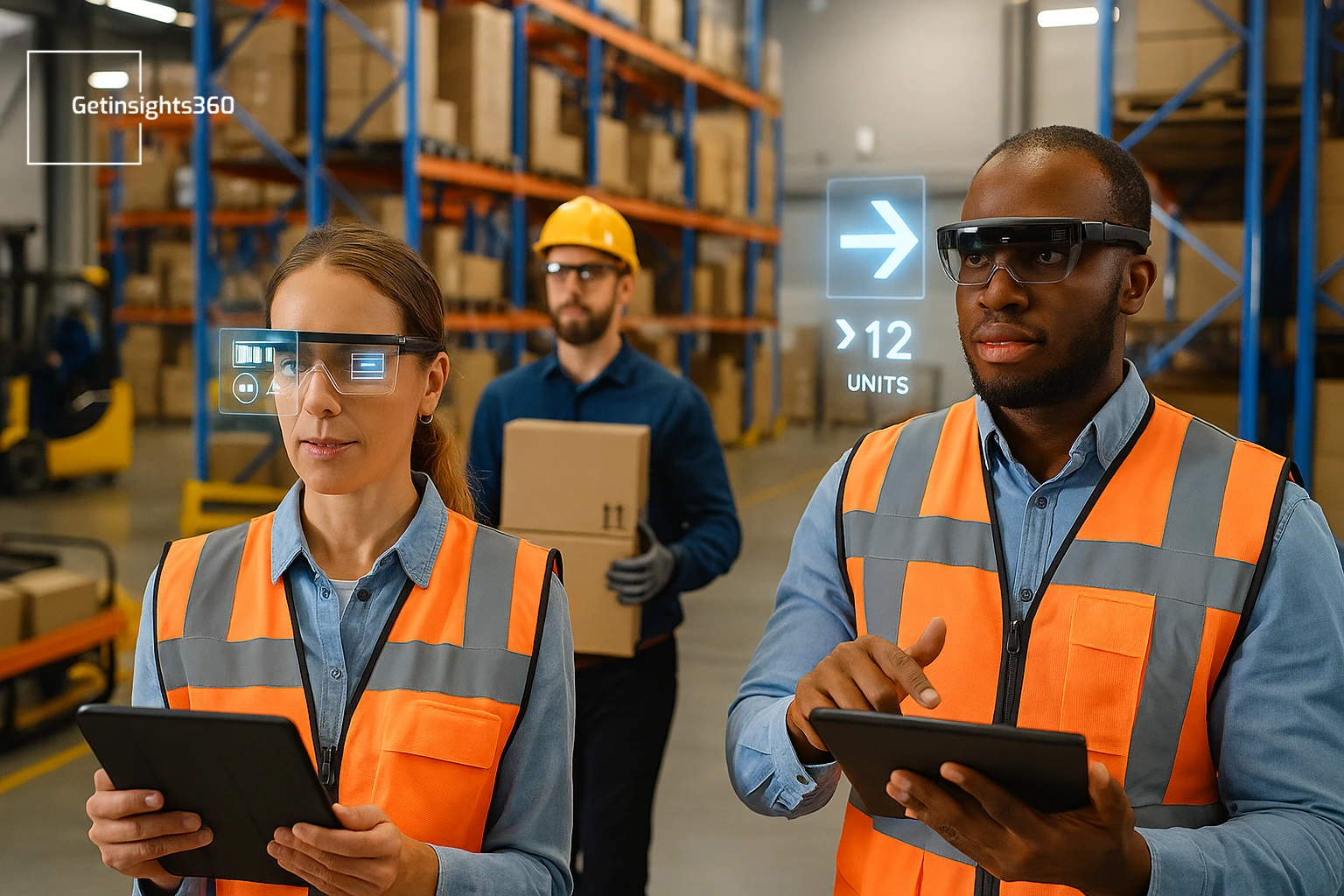
In today’s hyperconnected world, speed, accuracy, and visibility define warehouse success. Companies are under constant pressure to move goods faster, manage inventory efficiently, and keep errors to a minimum. Amid this challenge, Augmented Reality (AR) has emerged as a powerful tool to modernize warehouse operations. The adoption of augmented reality in warehouse processes is helping businesses bridge the gap between human capability and digital intelligence, unlocking new levels of efficiency and accuracy.
How Augmented Reality Is Transforming Warehouses
Warehouses have traditionally relied on barcode scanners, paper checklists, and manual oversight. These methods, though reliable in the past, now limit scalability and agility. AR solutions for warehouse management replace these outdated tools with visual, data-driven guidance.
Workers equipped with AR glasses or tablets can see digital overlays showing item locations, picking routes, or safety instructions directly in their field of vision. This hands-free warehouse operation reduces the need to constantly check handheld devices or printed sheets. Instead, employees can focus on completing tasks faster and with fewer mistakes.
Major logistics players, including DHL and Amazon, have already integrated AR-based picking systems into their workflows. The result? Faster order fulfillment, better accuracy, and improved employee satisfaction.
Smarter Inventory Management and Real-Time Visibility
A core challenge in warehouse operations is managing massive volumes of inventory while maintaining real-time visibility. Traditional methods often lead to stock inaccuracies and time-consuming searches. With inventory management using AR, employees can instantly locate products through visual cues projected onto their view.
AR overlays highlight where an item is stored, display stock levels, and even suggest optimal routes through the warehouse. This not only minimizes human error but also saves hours of manual tracking.
In addition, real-time inventory tracking with AR enables continuous synchronization with warehouse management systems (WMS), ensuring data accuracy and faster decision-making. The ability to visualize stock flow across zones helps supervisors identify bottlenecks and optimize space utilization.
Enhancing Picking Accuracy and Speed
Order picking represents up to 55 % of total warehouse operating costs. AR-based picking systems transform this process by guiding workers through digital arrows and markers. In real-world deployments, augmented-reality headsets have improved picker productivity by up to 15 % in logistics operations.
Instead of reading printed labels or handheld scanners, employees can simply follow the on-screen indicators shown via AR glasses. This visual picking and packing method reduces picking errors and increases productivity.
For example, when a worker looks at a rack, the AR interface highlights the correct shelf and product, confirms the order ID, and even provides quality instructions — all without breaking workflow. Businesses using these smart warehouse technologies and an Augmented Reality Warehouse Management System report a 20–30% improvement in pick rate efficiency.
Workforce Training and Safety Through AR
Employee onboarding and training can be time-consuming and costly, especially in large facilities. AR employee training systems allow new hires to learn in an immersive, interactive environment. Workers can practice tasks virtually before stepping onto the floor, reducing the need for constant supervision.
This type of warehouse training with AR accelerates learning curves, improves knowledge retention, and minimizes downtime. For instance, trainees can follow 3D visual guides to learn equipment handling or inventory sorting in a simulated space, making the process safer and more engaging.
Safety is another critical benefit. AR navigation in warehouses can alert workers about restricted areas, moving machinery, or hazardous zones. Forklift operators using augmented reality forklift navigation gain better spatial awareness, lowering the risk of accidents and improving compliance with safety standards.
Driving Efficiency and ROI
Implementing augmented reality in warehouse operations may seem like a futuristic investment, but the return on investment (ROI) is tangible. The combination of real-time data, visual cues, and automation leads to measurable improvements in throughput, accuracy, and labor efficiency.
Cost savings with augmented reality often stem from reduced training hours, fewer picking errors, and faster fulfillment cycles. Over time, these savings compound to deliver strong ROI for logistics firms, manufacturers, and e-commerce warehouses alike.
Moreover, AR Solutions for Businesses are enabling organizations to connect these warehouse efficiencies with broader digital transformation goals. The synergy between AI and AR in warehouse operations is amplifying these benefits — artificial intelligence can analyze performance metrics, predict inventory shortages, and optimize routing, while AR delivers that insight visually to workers in real time
Applications Across Industries
While logistics is the primary arena for augmented reality in warehouse applications, the technology is reshaping multiple sectors.
In manufacturing warehouses, AR helps workers visualize assembly processes, perform inspections, and ensure quality control. In retail logistics, it assists with product tracking, stock replenishment, and order accuracy. For e-commerce fulfillment, AR enables faster sorting and packaging, improving delivery times and customer experience.
Even warehouse automation with AR is on the rise, where AR systems work alongside robots and automated vehicles to synchronize human and machine tasks seamlessly.
The Future of Warehouse Operations with AR
As we step deeper into the Industry 4.0 era, AR is becoming an integral part of the connected warehouse ecosystem. The fusion of augmented reality, AI, IoT, and robotics is setting new standards for operational intelligence.
Future wearable AR tech for warehouse staff will be lighter, more ergonomic, and capable of integrating with enterprise systems through the cloud. Managers will be able to monitor performance dashboards in real-time, while employees receive instant task updates through visual cues.
Emerging AR trends in warehouse technology suggest deeper integration with spatial computing in logistics — enabling digital twins, predictive maintenance, and interactive 3D warehouse simulations.
Challenges to Consider Before Implementation
Despite the potential, businesses must address a few key challenges before adopting AR. Infrastructure readiness is essential — warehouses need stable connectivity and compatible devices for seamless AR experiences.
Scalability also matters; many organizations start with small pilot projects before rolling out AR across all locations. Employee adaptation can take time too, so investing in proper training and support is crucial.
Finally, selecting the right augmented reality devices for enterprises — whether glasses, headsets, or tablet solutions — can determine the success of deployment. Compatibility with existing WMS and ERP systems should be prioritized to avoid workflow disruption.
Conclusion
The rise of augmented reality in warehouse management represents more than just a technological upgrade — it’s a shift toward intelligent, human-centered efficiency. AR empowers workers to perform better, enhances visibility across operations, and helps businesses scale without compromising accuracy or safety.
From inventory management using AR to warehouse automation with AR, the technology is redefining how modern supply chains operate. As AR devices evolve and integration with AI deepens, warehouses will continue transforming into data-driven, immersive environments that deliver speed, precision, and innovation at every step.
In the race for efficiency and reliability, those who embrace augmented reality solutions today will lead the logistics revolution of tomorrow.
💡 Stay tuned to Getinsights360 for more insights and updates on emerging technologies across AI, ML, AR/VR, Blockchain, RPA, IoT, and Cybersecurity
FAQs
Augmented reality in warehouse management uses digital overlays and AR devices to enhance inventory tracking, order picking, and workforce productivity in real-time.
The science behind AR combines computer vision, motion sensing, and scene understanding to help warehouse teams visualize digital information in real-world environments, improving tasks such as order picking, navigation, and workflow efficiency.
AR-based picking systems guide workers visually to the right items, reducing search time, improving accuracy, and boosting overall picking speed and efficiency.
An Augmented Reality Warehouse Management System integrates AR tools with warehouse data, improving visibility, automating tasks, and enabling smarter, data-driven operations.
AR Solutions for Businesses reduce operational errors, streamline workflows, enhance training, and enable faster order fulfillment — all contributing to higher ROI.
Industries like e-commerce, manufacturing, retail logistics, and supply chain operations gain the most from augmented reality due to faster processes and improved accuracy.