 By Madhavan A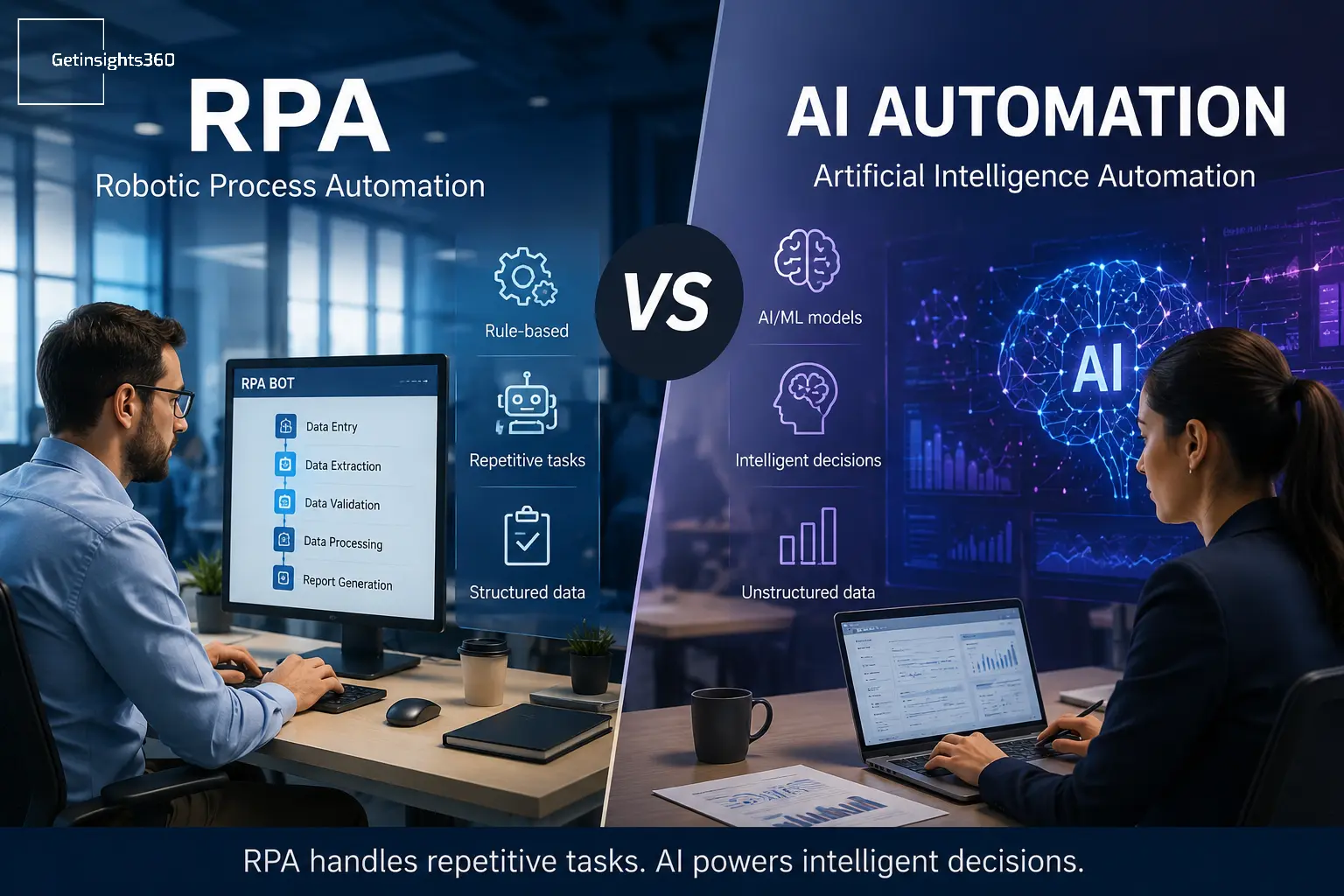
Businesses today are under constant pressure to improve efficiency, reduce operational costs, and deliver faster services. This is where automation technologies are making a major impact. Among the most discussed technologies are Robotic Process Automation (RPA) and Artificial Intelligence (AI) automation. While both aim to automate business operations, they work in very different ways.
Understanding RPA vs AI Automation is important for organizations planning digital transformation initiatives. Many people assume they are the same, but each technology solves different business problems. In many cases, companies even combine them to create smarter workflows.
In this guide, you will learn the key differences, use cases, advantages, limitations, and future trends related to RPA and AI automation.
What is RPA?
Robotic Process Automation (RPA) is a technology that uses software bots to automate repetitive and rule-based tasks. These bots mimic human actions such as clicking buttons, copying data, filling forms, generating reports, and moving files between systems.
RPA works best when processes follow fixed rules and structured workflows.
Common examples of RPA include:
- Invoice processing
- Employee onboarding
- Data entry automation
- Payroll processing
- Report generation
- Banking transaction verification
For example, in a banking system, an RPA bot can automatically verify customer details, transfer data between applications, and generate compliance reports without human involvement.
Many businesses use RPA because it reduces manual work, minimizes errors, and improves operational speed.
What is AI Automation?
AI automation combines artificial intelligence technologies with automation systems to handle tasks that require learning, reasoning, prediction, or decision-making.
Unlike traditional RPA, AI systems can analyze unstructured data such as emails, images, voice recordings, and customer conversations. AI automation learns from patterns and improves over time.
Examples of AI automation include:
- AI chatbots
- Fraud detection systems
- Predictive analytics
- Voice assistants
- Recommendation engines
- AI-based customer support
For instance, an AI-powered customer service system can understand customer questions, analyze intent, and provide intelligent responses automatically.
This makes AI automation suitable for dynamic environments where decisions are not always based on fixed rules.
RPA vs AI Automation: Core Difference
The main difference between RPA and AI automation lies in how they process tasks.
RPA
- Follows predefined rules
- Works with structured data
- Performs repetitive tasks
- Does not learn from experience
- Requires clear workflows
AI Automation
- Learns from data and patterns
- Handles unstructured information
- Makes intelligent decisions
- Continuously improves
- Adapts to changing situations
In simple terms, RPA behaves like a highly efficient worker following instructions, while AI automation behaves more like a system capable of learning and making judgments.
Difference Between RPA and AI Automation
Understanding the difference between RPA and AI automation helps businesses choose the right solution for their needs.
| Feature | RPA | AI Automation |
|---|---|---|
| Technology Type | Rule-based automation | Intelligent automation |
| Data Type | Structured data | Structured and unstructured data |
| Learning Ability | No | Yes |
| Decision Making | Limited | Advanced |
| Adaptability | Low | High |
| Complexity | Easier to implement | More complex |
| Best For | Repetitive tasks | Cognitive tasks |
Businesses often start with RPA for simple workflows and later add AI capabilities for more advanced automation.
Robotic Process Automation vs AI in Real-World Scenarios
When comparing robotic process automation vs AI, the business use case matters greatly.
Example 1: Invoice Processing
Using RPA
An RPA bot extracts invoice data from a fixed template and enters it into accounting software.
Using AI Automation
AI systems can read invoices from different formats, detect anomalies, and identify fraudulent transactions automatically.
Example 2: Customer Support
Using RPA
RPA can route support tickets to the correct department.
Using AI Automation
AI chatbots can understand customer intent, answer questions, and resolve issues without human agents.
Example 3: Recruitment
Using RPA
RPA automates candidate data entry and interview scheduling.
Using AI Automation
AI analyzes resumes, predicts candidate suitability, and identifies hiring trends.
Rule-Based Automation vs AI
One of the biggest comparisons in modern business technology is rule-based automation vs AI.
Rule-based automation follows predefined instructions. It cannot think, learn, or adapt beyond what it was programmed to do.
AI automation, however, can:
- Recognize patterns
- Understand natural language
- Predict outcomes
- Improve accuracy over time
For example:
A rule-based email automation system can forward emails containing specific keywords.
An AI-based email system can understand context, prioritize urgent emails, detect sentiment, and recommend responses.
This makes AI more flexible for complex business environments.
Different Types of RPA
There are several different types of RPA used in organizations today.
1. Attended RPA
Attended RPA bots work alongside employees. They assist humans with tasks like form filling, customer support, and data retrieval.
Example:
A customer service representative uses an attended bot to instantly retrieve customer account information during calls.
2. Unattended RPA
Unattended bots work independently without human intervention. These bots are commonly used for back-office operations.
Example:
Automated payroll processing during non-working hours.
3. Hybrid RPA
Hybrid RPA combines attended and unattended automation to create more flexible workflows.
Example:
A healthcare system where attended bots help staff enter patient information while unattended bots process insurance claims automatically.
Intelligent Automation vs RPA
Another important comparison is intelligent automation vs RPA.
Intelligent automation combines RPA with AI technologies such as machine learning, natural language processing, and computer vision.
While RPA alone automates repetitive tasks, intelligent automation can:
- Analyze data
- Understand text and speech
- Make predictions
- Handle exceptions
For example, a traditional RPA bot may struggle if invoice formats change. An intelligent automation system can adapt and continue processing invoices accurately.
This combination is becoming increasingly popular across industries such as healthcare, banking, logistics, and retail.
RPA and AI Integration
Today, many companies focus on RPA and AI integration instead of choosing one technology over the other.
Combining RPA with AI allows organizations to automate both repetitive and decision-based tasks.
Benefits of RPA and AI Integration
Improved Efficiency
RPA handles repetitive workflows while AI manages analysis and decision-making.
Better Accuracy
AI can detect anomalies and reduce errors in automated processes.
Enhanced Customer Experience
AI chatbots combined with RPA systems can resolve customer requests faster.
Scalability
Businesses can automate larger and more complex operations.
Real-World Example
In the insurance industry:
- AI analyzes claim documents and detects fraud patterns.
- RPA bots transfer approved claims into payment systems.
- The result is faster claim processing and reduced operational costs.
This combination is transforming digital business operations globally.
AI-Powered Automation for Businesses
Modern organizations are rapidly adopting AI-powered automation for businesses to stay competitive.
AI automation helps businesses:
- Reduce manual workloads
- Improve customer service
- Increase productivity
- Make faster decisions
- Analyze large volumes of data
Industries using AI-powered automation include:
- Banking
- Manufacturing
- Healthcare
- Retail
- Logistics
- Telecommunications
For example, retailers use AI-powered automation to analyze customer behavior and recommend personalized products in real time.
Manufacturing companies use AI systems to predict machine failures before breakdowns occur.
These technologies are helping organizations become more efficient and data-driven.
Top RPA Monitoring Tools
Monitoring is essential for successful automation management. Several organizations rely on Top RPA Monitoring Tools to track bot performance, errors, and workflow efficiency.
Popular RPA monitoring tools include:
- UiPath Insights
- Automation Anywhere Control Room
- Blue Prism Control Center
- Microsoft Power Automate Analytics
- Splunk for RPA Monitoring
These tools help businesses:
- Monitor bot activity
- Detect failures quickly
- Improve workflow performance
- Generate operational reports
- Ensure compliance and security
Proper monitoring ensures automation systems remain reliable and scalable.
Benefits of RPA and AI Automation
Both RPA and AI automation offer significant business advantages.
Key Benefits
Cost Reduction
Automation reduces manual labor costs and operational expenses.
Faster Processing
Tasks that once took hours can now be completed within minutes.
Improved Accuracy
Automation minimizes human errors in repetitive workflows.
Better Productivity
Employees can focus on strategic and creative work instead of repetitive tasks.
Enhanced Customer Experience
Faster service delivery improves customer satisfaction.
Challenges of RPA and AI Automation
Despite the advantages, businesses may face challenges during implementation.
Common Challenges
High Initial Investment
Advanced AI automation systems can be expensive to deploy.
Integration Issues
Connecting automation tools with legacy systems may be difficult.
Employee Resistance
Workers may fear job displacement due to automation.
Data Quality Problems
AI systems require high-quality data for accurate results.
Maintenance Requirements
Automation workflows require regular updates and monitoring.
Organizations should plan carefully before implementing large-scale automation projects.
Future of RPA and AI Automation
The future of automation is moving toward hyperautomation, where businesses combine RPA, AI, analytics, and cloud technologies into unified systems.
Future trends include:
- AI-driven business process automation
- Self-learning automation systems
- Intelligent virtual assistants
- Autonomous decision-making workflows
- Predictive automation platforms
As technology evolves, businesses will increasingly adopt intelligent automation solutions that combine the strengths of both RPA and AI.
Conclusion
Understanding RPA vs AI Automation is essential for businesses planning digital transformation strategies. RPA is ideal for repetitive and rule-based processes, while AI automation excels in decision-making and learning from data.
Instead of viewing them as competing technologies, organizations should consider how RPA and AI can work together. The combination of automation and intelligence enables businesses to improve efficiency, reduce costs, and deliver better customer experiences.
As industries continue adopting digital technologies, AI-powered automation and intelligent RPA solutions will play a major role in shaping the future of business operations.
💡 Stay tuned to Getinsights360 for more insights and updates on emerging technologies across AI, ML, AR/VR, Blockchain, RPA, IoT, and Cybersecurity
FAQs
RPA automates repetitive rule-based tasks, while AI automation can learn from data, analyze patterns, and make intelligent business decisions automatically.
Yes, businesses combine RPA and AI to automate repetitive tasks while enabling intelligent decision-making, improving efficiency, accuracy, and customer experience.
Industries like banking, healthcare, manufacturing, retail, and logistics widely use AI-powered automation for analytics, customer support, and operational efficiency improvements.
The main types of RPA are attended RPA, unattended RPA, and hybrid RPA, each designed for different business automation requirements and workflows.
RPA monitoring tools help businesses track bot performance, identify workflow errors quickly, improve efficiency, and maintain automation system reliability and compliance.